This time of year there are plenty of homeless and pavement artistes enjoying the late summer warmth of Brighton and Hove.
In the city centre I can usually rely on two or three 'artists' with chalk who outline colourful designs (or copy classic pictures), with an attached appeal for contributions.
Today I was stopped in my tracks by a new artiste who was modelling in sand.
It was a really excellent effort and I was happy to contribute!
Wednesday, 24 September 2014
Wednesday, 17 September 2014
Is Prayer Worth the Effort?
During the past month two middle-aged friends died of cancer.
For years I had been praying for their full recovery...but they died
(peacefully in both cases). Was the prayer a wasted effort?
Few scientifically-rigorous surveys have been done of the
efficacy of intercessory prayer. One of the most famous recent ones was the
STEP (Study of the Therapeutic Effects of intercessory Prayer) in 2006, which
used double-blind protocols and randomized patient groups. Here 1,802 coronary
artery bypass patients at six hospitals were prayed for by the congregations of
three Christian churches
However...the prayed-for patients’ group suffered slightly
worse from 30-day mortality and complications than the group who were not
prayed for; worst off were the patients who were both prayed for and were also
told that they would be prayed for - in
the later case it was suggested that being told they would be prayed for may
have made them fear that they were exceptionally sick – needing prayers! - and
thus made them more susceptible to disease.
The limited number of meta-studies of controlled research into
multiple prayer efforts also suggests that prayer has little or no positive
effect. What conclusions can we draw?
First, there is plenty of anecdotal evidence that points to
positive outcomes for personal prayer, for prayer said for family members or
friends (as opposed to groups of people praying for other groups of people). Second,
it is impossible to quantify the ‘mass’ or ‘quality’ of prayer efforts directed
by or for individuals or groups, or to understand the workings of prayer
mechanics (or to segregate the impact of third party prayer activity) so I’m
not convinced ‘scientific’ research is meaningful in this area. Third, for
Christians, I suspect it is improper and probably self-defeating to effectively
challenge the author of the source of healing to cooperate in demonstrations, as
if we were looking for magic or a cause and effect mechanism.
So, is it still worth praying, especially praying for
others?
Undoubtedly. The Bible is full of instructions to pray, relentlessly,
in confidence and faith - it even gives a recommended format in the ‘Our Father...’ In the book of James, the author specifically recommends
praying for the sick. While all prayers are heard, we are told that the prayers
of the righteous are particularly powerful, however, nowhere does it guarantee that
the results will be what we desire. The anticipatory model is that of
Gethsemane, where Jesus, distressed and in agony, first prayed for the cup to
be removed from Him (and then that the will of His Father be done).
As usual, the Catechism has a wise angle on matters. While
the Vatican II-inspired full Catechism of
the Catholic Church is an unerring guide on matters of faith, I’ve been
increasingly struck by the Youcat, a
brilliant contemporary version aimed at youth.
It’s a practical reference too. For example, it quotes the
saintly Cure of Ars who advised a brother priest complaining of a lack of
success in his prayers ”You have prayed,
you have sighed...but have you fasted too? Have you kept vigil?’ Or perhaps
we are asking for the wrong things; St. Teresa of Avila once said “Do not pray for lighter burdens, pray for a
stronger back.”
It makes the point that true prayer does not aim for a
superficial success but for increasing intimacy with God. The saints also struggled
with prayer, experiencing interior emptiness and dryness, even an occasional aversion
to prayer, but ‘to persevere faithfully
is itself a prayer’...God’s apparent
silence is itself an invitation to take a step further – in total devotion,
boundless faith, endless expectation. Anyone who prays must allow God the
complete freedom to speak whenever He wants, to grant whatever He wants, and to
give Himself however He wants.’
What I understand from this is that, in a sense, the goal of prayer is not external results but
conversion, our prayer becoming our life.
Mmmh... Sunday, 14 September 2014
Festival Time
Today was the Arundel & Brighton region of the Saint Vincent de Paul (SVP) Society's annual Festival meeting. It was held at Henfield, a large village in West Sussex, about 33 miles south of London, 12 miles north-west of Brighton.
As usual, the Festival began with Mass in the modern red brick church of Corpus Christi. Finding the church can be a challenge; it is reached via increasingly narrow roads, tunnel-like winding lanes with high hedges on either side, past mysterious muddy tracks, past the medieval bulk of the Anglican church of St. Peter, past great houses with acres of tidy lawn.. and suddenly you're there.
The car park was full and for the first time I saw the newly-acquired minibus of Brighton District SVP. This nine-seater is used to transport the elderly and infirm (so that can go shopping, on trips, attend medical and other appointments, go to Mass etc) and also to carry goods for the society's charity shop.
Mass began on time at 3.00pm. Bishop Kieran Conry was the main celebrant assisted by the parish priest, Fr. David Maskell, and Deacon Seamus Mahan, who is also Spiritual Adviser to the SVP. There were about 60 SVP members in attendance and, while the choir and organist were few in number, they were brilliantly effective. The National President of the SVP in England & Wales, Adrian Abel, and his wife Mary attended; Adrian read the first reading, A&B CC President Ingrid Phillips read the second.
Afterwards we gathered in the parish hall where several tables were covered in a huge variety of cakes, sandwiches, biscuits, petit fours and other confectionaries. There was a disconcerting amount of cream in bowls and the thought struck me that, if I sat down, I might never get up again...so I stood.
That was a mistake, as I had not anticipated the length of Adrian Abel's speech - to be fair, he did give some warning! - and was on my feet for what felt like a couple of hours but was probably only one hour and fifty-five minutes...
We began with a tribute to a long-serving member, Tony, who had joined the SVP more than 50 years ago. Bishop Kieran and President Adrian honoured him with a certificate, award - and a slice of cake. (In the picture below he is reading his prepared words of thanks, as Bishop Kieran, Adrian and Ingrid look on).
It was the first time that I had heard Adrian address a large meeting and he was a confident, interesting speaker with a clear and robust delivery. As Bishop Kieran had done in his homily, he paid tribute to the work done by the SVP in the region. Interestingly, he stressed the 'fellowship' aspect of Conference membership, mentioning that the term might be more familiar to an evangelical and Protestant audience, but was also a reality of the SVP experience. He also stressed the need to recruit new members, using a variety of proven techniques, in the face of reducing numbers.
The influence of Pope Francis was also evident in his appeal for the SVP to work in different, more difficult areas (he spoke appreciatively of the work done locally on soup runs, night shelters, furniture scheme etc.); to engage with young people; communicate more effectively and with a wider population; to share resources, and work with other churches - and with those of no faith - in order to serve those in need.
Mass in a warm, friendly church...important messages to ponder over...tasty cakes...another great day!
As usual, the Festival began with Mass in the modern red brick church of Corpus Christi. Finding the church can be a challenge; it is reached via increasingly narrow roads, tunnel-like winding lanes with high hedges on either side, past mysterious muddy tracks, past the medieval bulk of the Anglican church of St. Peter, past great houses with acres of tidy lawn.. and suddenly you're there.
The car park was full and for the first time I saw the newly-acquired minibus of Brighton District SVP. This nine-seater is used to transport the elderly and infirm (so that can go shopping, on trips, attend medical and other appointments, go to Mass etc) and also to carry goods for the society's charity shop.
Mass began on time at 3.00pm. Bishop Kieran Conry was the main celebrant assisted by the parish priest, Fr. David Maskell, and Deacon Seamus Mahan, who is also Spiritual Adviser to the SVP. There were about 60 SVP members in attendance and, while the choir and organist were few in number, they were brilliantly effective. The National President of the SVP in England & Wales, Adrian Abel, and his wife Mary attended; Adrian read the first reading, A&B CC President Ingrid Phillips read the second.
Afterwards we gathered in the parish hall where several tables were covered in a huge variety of cakes, sandwiches, biscuits, petit fours and other confectionaries. There was a disconcerting amount of cream in bowls and the thought struck me that, if I sat down, I might never get up again...so I stood.
That was a mistake, as I had not anticipated the length of Adrian Abel's speech - to be fair, he did give some warning! - and was on my feet for what felt like a couple of hours but was probably only one hour and fifty-five minutes...
We began with a tribute to a long-serving member, Tony, who had joined the SVP more than 50 years ago. Bishop Kieran and President Adrian honoured him with a certificate, award - and a slice of cake. (In the picture below he is reading his prepared words of thanks, as Bishop Kieran, Adrian and Ingrid look on).
It was the first time that I had heard Adrian address a large meeting and he was a confident, interesting speaker with a clear and robust delivery. As Bishop Kieran had done in his homily, he paid tribute to the work done by the SVP in the region. Interestingly, he stressed the 'fellowship' aspect of Conference membership, mentioning that the term might be more familiar to an evangelical and Protestant audience, but was also a reality of the SVP experience. He also stressed the need to recruit new members, using a variety of proven techniques, in the face of reducing numbers.
The influence of Pope Francis was also evident in his appeal for the SVP to work in different, more difficult areas (he spoke appreciatively of the work done locally on soup runs, night shelters, furniture scheme etc.); to engage with young people; communicate more effectively and with a wider population; to share resources, and work with other churches - and with those of no faith - in order to serve those in need.
Mass in a warm, friendly church...important messages to ponder over...tasty cakes...another great day!
Thursday, 11 September 2014
A Day of Guns and Crabs
Yesterday we spent a day in London at one of our favourite venues, the Imperial War Museum. This splendid museum, stuffed with warplanes, tanks, cannons, uniforms, firearms and all the hideous panoply of war is located - very appropriately - in what was the former Bethlem Royal Hospital building, built about two hundred years ago. The hospital was the first to specialise in the mentally ill, and gave rise to the expression 'bedlam' describing chaos or madness. I rest my case!
The museum was closed for six months in 2014 to allow a £40 million renovation to proceed, including the creation of new galleries to tell the story of the First World War, which began 100 years ago.
Outside the entrance is a massive pair of 15 inch naval guns, each weighing about 100 tons and capable of firing a 2,000-pound shell more than 16 miles. The guns were originally mounted on battleships and were last fired in anger during the Second World War; one of them pounded enemy shore batteries near Normandy Beach on D-Day, 1944.
Inside, and the first disappointment. After renovations, the once-splendid atrium has been reduced in size and the side walls seem to be hemming in the various planes and rockets hanging from the roof. The immediate impression is of a cramped space stuffed with inappropriately large objects.
Lurking in a corner was a Russian T34 tank, a simple but revolutionary design, with allegedly the best balance of firepower, mobility (32mph!), protection and ruggedness of any tank in the Second World War. Easy to manufacture, they were knocked out in their tens of thousands and are still being used in certain African countries.
I was fascinated by the crudeness of the steel detailing. It almost seems like a piece of clay from the junior school modelling class - still bearing the imprint of the clumsy tool marks!
Fortunately, the new First World War display galleries are well laid out and well illustrated. They are so popular that entry is by timed ticket; we had to wait from 2.00pm to 3.45pm before we could enter.
On the second and third floors there is a new layout and the number of items on display seems to have been significantly reduced. (Younger son asked if the museum had sold off much of its collection - good question!). There are no longer, for example, displays of post-1945 conflicts such as the Mau Mau rebellion (I remember the incredible display of home-made weapons, including 'zip' guns fashioned from car aerials, rubber tubing and cartridges).
Worse, the displays are now arranged in thematic zones, the parameters of which are not always clear. No longer can you go up to an object, read the description and move on. Now you must search for the information board, locate your item's illustration on the board and read the accompanying description. I searched for ages but could not find the description label of what looked like a metal operating theatre table from the Falklands Conflict.
The only saving grace is that the art gallery, medals room and the Holocaust exhibition have escaped the renovation vandals.
On leaving soon after 6.00pm I thought we could pop into the nearby St. George's R C Cathedral and say a prayer for all the fallen. Alas, it was shut. (Fortunately God is not confined to buildings or at the mercy of planners and designers).
Instead, we went to lunch in a small Taiwanese restaurant in Chinatown. This was elder son's pilgrimage. He wanted to sample - deep breath - typhoon shelter crab; xiao long bao; braised pig's trotter; crispy shredded turnip puff; Taiwanese oyster omelette and Taiwanese pork buns.
And that's what we got - except for the crab; they had run out of crabs...but, assessing his seriousness, they relented, offered to go and buy one from a nearby shop and then cook it specially for him. Now, that's service!
While the others waited, younger son and I headed off to Foyle's Bookshop, London's largest and most famous independent bookshop. It too has been remodelled a few months ago, moving into a new building (the former Central Saint Martin's Art School) just a few doors away from their old building. It's huge, eight levels, 37,000 square feet and holding more than 200,000 titles, reportedly the largest bookshop in the UK. (The only competitor that I can think of - Waterstones Piccadilly - has 150,000 titles in stock).
I bought a book on poetry and we returned to the restaurant to find a contented elder son and his mum surrounded by the debris of their crab dish; pieces of shell, empty claws, small chunks of garlic, chillies, bits of spring onions, and well-used crab crackers and metal picks.
Then it was out into the cool night of Gerrard Street to admire the lights and lantern decorations for Mid-Autumn Festival.
Wednesday, 10 September 2014
Sunday, 7 September 2014
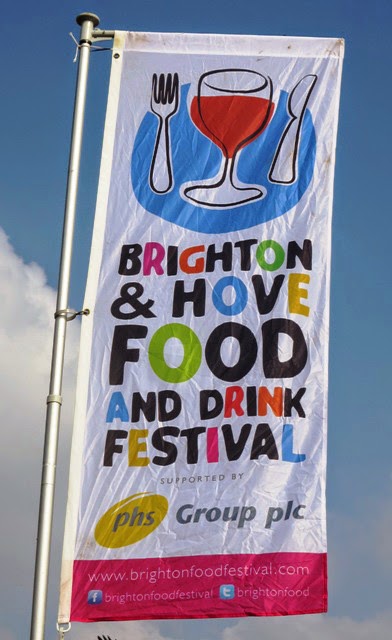
Feast For Foodies: Brighton & Hove Food and Drink Festival
It was a lovely warm day, 21 degrees (70F) with blue skies and a light onshore breeze. Hundreds of tourists and locals were already crowding the Festival's food and drink stalls - several dozen of them - or queuing outside the marquee where cooking displays are held. Elder son, a determined foodie, led the charge.
I've got a taste for sausages...I blame several winters spent working in Frankfurt, Germany, when, after work each day, I would enjoy a plate of currywurst and a glass of apfelwein on the way home (or even a glass of gluhwein if it was bitterly cold).
So, today's first stop for me was the bratwurst with a liberal dash of curry ketchup, helped down by a glass of Harvey's Olympia Golden Ale, a light summer drink only brewed between April and September.
Soon it was time to eat again. This time I chose a Jamaican curried goat meal with brown rice and beans, from a stall decked out in Jamaican flags and the national colours of black, gold and green, staffed by a couple of guys wearing crocheted rastacaps. The goat was excellent; mildly flavourful, tender with a tasty sauce.
Elder son, who is rather adventurous in food, being both a gourmet and (whisper it) a gourmand, had by this time sampled Guinness W. Indian porter ale, an Indian paneer roll, a lamb samosa, surf & turf (grilled steak and prawns) and a glass of ale.
By this time the mixture of hot sun and full stomachs was beginning to tell. For me it was dessert time, an ice cream sundae with hot caramel - scrumptious (but the missus, who had been surprised by the heat of some chilli-flavoured food, scoffed much of it!). Elder son, not to be outdone, bought some baklava, a super-sweet Turkish dessert made of paper-thin layers of filo pastry filled with chopped nuts and saturated with syrup or honey...and two jars of hot chilli sauce.
Quite a day - thanks to elder son for insisting we come and keep you company!
Saturday, 6 September 2014
Working as Catechists or Being Cartechists?
Over twenty catechists from the Brighton Deanery met at the Sacred
Heart Church in Hove today for a morning of prayer,
instruction and reflection, led by David Wills, A&B’s Adult Formation
Adviser.
Key to the session was Pope Francis’ challenge to us to ‘be’ catechists, not simply to’ work as’ catechists.
Catechesis should be much more than teaching, imparting knowledge. We are asked to lead people to Christ by our words and our lives, by giving joyful witness. We can do this by being close to Jesus and by going out of our comfort zone to encounter others - even by going to the margins where we are challenged and uncomfortable.
Unspoken - but at the back of our minds - was the inspiring
example of Pope Francis himself, a joyful and humble catechist who reaches out
in love to prisoners, migrants, the ill, the poor and the wretched at society’s
margins.
We are all called to be catechists. A wise person once said: ‘faith is caught, rather than taught’. Does our faith infect others?
Key to the session was Pope Francis’ challenge to us to ‘be’ catechists, not simply to’ work as’ catechists.
Catechesis should be much more than teaching, imparting knowledge. We are asked to lead people to Christ by our words and our lives, by giving joyful witness. We can do this by being close to Jesus and by going out of our comfort zone to encounter others - even by going to the margins where we are challenged and uncomfortable.
As Pope Francis put it ‘I would prefer...a catechist with
the courage to risk going out, and not a catechist who is studious, knows
everything but is always closed...’
We considered the five stages people typically go
through in the process of full commitment to Jesus, took a hectic one-hour
journey through an abbreviated Kerygma
Bible Retreat course, and ended with a fascinating presentation on coaching
parents to be the providers of their children’s religious education.
We are all called to be catechists. A wise person once said: ‘faith is caught, rather than taught’. Does our faith infect others?
Subscribe to:
Posts (Atom)