Thursday, 20 March 2014

Hong Kong Junk (of a Different Kind)


The Hong Kong Tourism Board logo with its red-sailed junk is very familiar but my favourite Hong Kong junk is to be found in Apliu Street in Sham Shui Po, a working class area in the Kowloon Peninsula.


The whole area around the MTR station is a heaving mass of markets where all manner of things are sold, particularly fabrics, clothing and electronics.


Apliu Street market is officially referred to as either an electronic market or a flea market – and it is both. There are electronics a-plenty, whether your desire is for the latest technology or something used but still working, maybe a nice Olympia typewriter?  


Or maybe you need a replacement remote control or a cheap but working power drill, saw or hammer; you’ll find them here.


Maybe your tastes are for something more up to date?


There is a wealth of optics and electronics on display at more reasonable prices than elsewhere in the city. A couple of stalls specialise in film cameras of the 1950s to the 1980s, before all this digital stuff happened. Just across the street is the famous Golden Shopping Centre where, in the 1980s and 1990s, tens of thousands of savvy customers hurried to buy pirated software. The Centre still majors in computer electronics, especially motherboards and computer ‘innards’, but software piracy has been pretty much eradicated in Hong Kong (although ‘copy watches’ and replica handbags are still readily available in central Hong Kong areas such as Tsim Sha Tsui, although I'm sure the watches below from Apliu Street are the genuine article!).


I love the idea that there is a place for ‘Mom and Pop’ sellers too, it’s like a car boot sale where people want to dispose of much-loved but no longer used items or things that they have collected themselves – sometimes very ordinary things, sometimes a mix of old and new - and you can part exchange too (an idea that is just catching on in the the Broadway or Fortress electronics chain stores!).


But if you are looking for jade, old coins, vases, paintings, copies of the original Little Red Book, statues of Mao or curios of various kinds, they are there too. But you do have to rummage!  

  
Aplui Street is just one of dozens of specialist Hong Kong markets. There are obviously a large number of fruit, vegetable, seafood and meat (wet) markets, but the most interesting are the specialist markets: jade, flowers, goldfish, antiques, clothing, electronics, toys, computers, costumes, dried seafood, birds, fashion, Chinese medicine, sneakers, souvenirs...a favourite one for tourists is the Night Market, principally clothing and souvenirs but also open air snacks, opera singers and fortune tellers. No place does markets like Hong Kong!


Monday, 17 March 2014

Paying Homage to the In-Laws

This morning we were up at the crack of dawn…well, 9.00am actually, we are on holiday. The reason for the moderately early start was to travel to a cemetery in Sha Tin, a town in the mainland New Territories of Hong Kong , to pay homage to my late parents-in-law, whose ashes reside there. (It's Ching Ming festival time, the period each year when we visit the cemetery and sweep our ancestors' graves). 

The cemetery is on the outskirts of Sha Tin, built on the side of a wooded hill overlooking the town. It’s vast, covering several acres and contains about 100,000 memorial urns in a series of memorial halls stretching up the hill.


Because building land is very scarce in Hong Kong and there are now over seven million inhabitants, it’s very much a case of excess demand and limited supply. As a result, government cemeteries have long waiting lists and many commercial cemeteries have sprung up, like the one we were visiting.

(The price of a single urn box in one of the few remaining empty slots – in a memorial hall in a less favoured position in the cemetery – varies from HK$113,000 or about nine thousand pounds to HK$ 480,000 or thirty-seven thousand pounds. The price depends upon location within the hall, the most favoured position being mid-way up the rear wall, facing the entrance. That will guarantee that the remains will remain undisturbed until at least the year 2047. And, of course, the ambiance is excellent with good fung shui and the proximity of many images of Buddhist deities.)


At the entrance were two small shrines that all visitors pay their respects at. Paying respects means lighting three incense or joss sticks, bowing three times in succession to the shrine and placing the sticks in a burner. The first shrine is to – I’m not sure what his official title is – the ‘landlord’ deity of the hillside.


The second shrine is to all the deceased who have no relations or friends to visit and pay their respects…nice thought.

Then it’s a climb up the hill, assisted much of the way by a kind of funicular lift. 


Half way up there is a temple and a few shops where the necessary supplies can be bought. As we passed the temple there was a Taoist ceremony taking place, the sound of chanting and the striking of bells and clappers echoed through the complex, a few worshippers visible amid the clouds of incense.


Outside the temple were a variety of paper goods waiting to be burned. We Chinese believe that this act, accompanied by prayers, will fulfil our intention that the deceased receive the material equivalent of what was burned. So, if the deceased liked to travel, what better than his own plane?


Similarly, if he was well-off he will not want to queue for the tram or the bus. That means a car is in order, and, being Hong Kong, it should be at least a Mercedes – with chauffeur naturally.


Then there’s the house, a nice villa please.


Oh, and a servant or two as well. After all, there’s bound to be a lot of housework necessary to keep the villa in order, and cooking too.


Behind the temple was a sitting area with a golden Buddha in a large glass case and an ornamental pond where brightly coloured fish swam.


Then it was climbing again, up more stairs to our final destination, the memorial hall where the remains of my parents-in-law were deposited. 


This was a prime location with a giant statue of Buddha in a heptagonal piazza with seven memorial halls facing off from the seven sides. Each memorial hall contained several hundred urns, each with a photograph of the deceased and the basic details of the person’s life in gilt script.


We had prepared a variety of vegetarian food and fruit for the deceased together with small cups of tea (Pu Ergh, my father-in-law’s favourite). These would be ritually offered, and delivered to the deceased in the same way as the paper offerings. 


(Actually, much of the food would be taken home and eaten after the ceremony ended). There were warning notices asking visitors not to feed the wild monkeys, of which there were a large number in the area.


So, again, the ritual of bowing three times and offering joss took place, first to the Buddha, then to the in-laws, and finally there was a communal series of bows from the eight of us in unison to the in-laws.


Slightly higher than our memorial hall, on yet another level, was another plaza with three impressive gilt figures of Buddha and a view over the high-rise town of Sha Tin, far below. I stayed for a few minutes, enjoying the view and the silence, the faint sound of chanting wafting up from the temple below.    


Saturday, 15 March 2014

Hail Mighty Durian, King of Fruits!

One of the joys of coming to Hong Kong is that you are closer to the durian fruit, unique to South East Asia (and grown in several countries, particularly Thailand, Indonesia, Malaysia, the Philippines and Singapore).


The fruit from the nearby Malaysian peninsula only comes into season from June to August. The main exporting country is Thailand and its durian is available from mid-April to September. Unfortunately, we arrived in Hong Kong in March, too early in the year for fresh durian… however the ever-redoubtable missus performed a miracle and managed to obtain durian for tonight’s dessert!


It’s hard to describe the smell of durian…think blocked drains, smelly socks, over-ripe cheese, paint stripper, dead animals, onions…nothing can prepare you for it. No wonder it is barred from hotels, airlines, public transport and taxis when it is in season.


But discard the prickly husk and inside is a tender yellow ambrosia. Neither sweet nor sour, creamy, custardy, fibrous but silky smooth, almondy…again, mere words are insufficient. You must try it. It’s like discovering chocolate for the first time – but much better for you.  

Tuesday, 11 March 2014

A Measure of Hong Kong’s Independence?

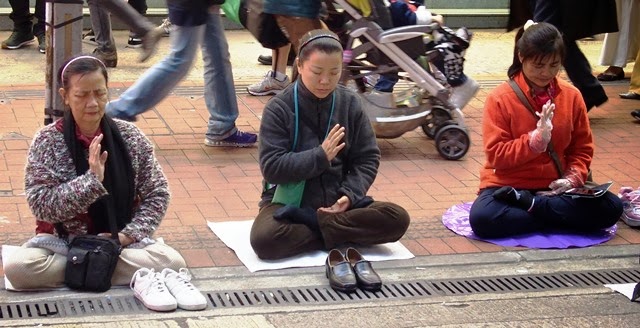
Many tourists to Hong Kong, especially those that visit the HK Tourist Board office on Kowloon pier, will have noticed the demonstrations by a group called Falun Dafa. Often there are members of the group demonstrating meditation techniques, usually there are graphic posters of alleged mainland Chinese brutality against its adherents, always there is loudspeaker propaganda and free leaflets.
  
Falun Dafa, originally called Falun Gong, was created in 1992 by a Chinese national called Li Hongzhi. It is a blend of meditation, slow-moving qigong movements and the cultivation of moral precepts, particularly truthfulness, compassion and forbearance. It quickly caught on and attracted tens of millions of followers in China (the group claims 100 million members by the late 1990s).

However, things changed dramatically when over 10,000 members held a peaceful demonstration outside the central government compound in Beijing in April 1999 requesting legal recognition and freedom from state interference. Perhaps feeling threatened by the size and independent objectives of the movement, the Communist Party leadership cracked down – hard. It outlawed the movement calling it heretical and a threat to stability and – according to human rights groups – subjected its members to a variety of abuses, including mass imprisonment, forced labour and torture. The founder, Li Hongzhi, moved to the USA in 1996 and Falun Dafa is still active worldwide with (it is claimed) hundreds of thousands of practitioners in 70 countries.

So, the fact that Hong Kong allows the Falun Dafa group to exercise its democratic right to demonstrate in public and share its views is a huge measure of Hong Kong’s own independence and China’s forbearance towards Hong Kong. Long may it continue.  

Causeway Bay
I was reminded of this the other evening when I was strolling around Causeway Bay, one of the busiest shopping areas on Hong Kong Island.

Falun Dafa meditators
The Falun Dafa people had set up their stalls on one of the main pedestrianized streets. There were meditators, several placards and a display apparently alleging that the authorities were harvesting organs from members held prisoner in mainland China – and there were plenty of posters with graphic photos of torture to back it up.


They did not have it all their own way however, a dispute broke out when I was there and some ladies began pushing and shoving each other (all the while trying to capture the dispute on their mobile phones!) The police swiftly moved in to separate the parties and peace was eventually restored.


Because this is Hong Kong, which is a major temple of consumerism, there was a more traditional demonstration going on just 20 yards away from the Falun Dafa folk. Poor girls, I’m sure they were frozen, the temperature was about 15 degrees Celsius with a bitter wind. 

cold ladies...
(UPDATE: FOUR DAYS LATER)

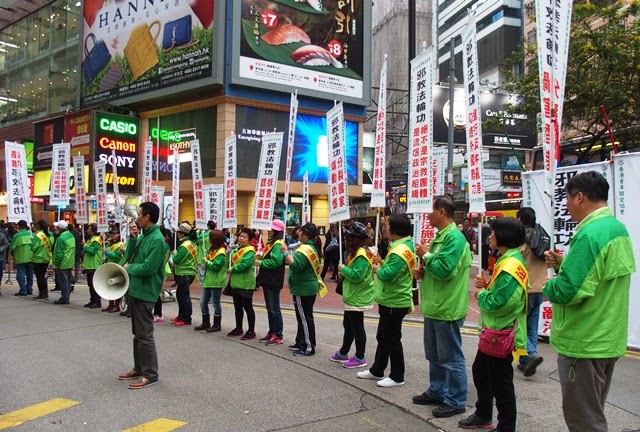
This afternoon there was an organised counter-demonstration, about 18 people dressed in uniform green jackets with yellow sashes who formed a line and shouted slogans in unison, led by a chap with a megaphone standing at the front.


And in case their message needed reinforcing, there was another gentleman with another megaphone at the back, adding to the din...


Of course, the Falun Dafa people weren't going to be deafened without retaliating and a couple of them approached the demonstrators with their own megaphone. The police- who I hope were wearing earplugs - kept the peace as usual.


As I stood there photographing a young man sidled up to me and began talking:

"You shouldn't think these demonstrators in the green jackets are Hong Kong people. They are from the mainland, Communists. They're poorly educated, recent immigrants to Hong Kong who can't find jobs, so the Chinese authorities pay them to demonstrate against the Falun Dafa people. Sometimes they start violence, hitting them, not just shouting at them."

"Are you a member of Falun Dafa?" I asked.

He hesitated for a moment, then said "I support them but I am not a member."

Hmmmmm. 

Sunday, 9 March 2014

Japanese Bishops’ Extraordinary View on the Use of Natural Law

In 2013 the Roman Curia published a questionnaire in preparation for the October 2014 Synod of Bishops on the family. I took a look at it early on with a view to responding and soon gave up; I’ve rarely seen a more tortuous and convoluted example of Geek-speak. Thankfully, some enlightened dioceses – including our own A&B - produced simplified versions, but I suspect that much goodwill and momentum had already been squandered.  

Few countries have made public the full results of their own national questionnaire (although Germany, which has a few axes of its own to grind, was an early exception).
Now Japan is the first Asian country to publish the results of its survey, according to today’s ‘Sunday Examiner’ newspaper, which is published by the Bishop of Hong Kong.

The Japanese bishops, in a report on the survey, complain that when Church leaders cannot justify things, they ‘call it natural law and demand obedience on their say-so.’ The bishops further question why natural law needs to be taught if it is indeed natural, and add that, in Japan, ’it is perceived as abstract and out-of-touch.’  
Not surprisingly, the questionnaire found that Japanese Catholics absorb many of their post-modern society’s views on divorce, remarriage, contraception and abortion

However, there was one aspect of the Church’s activity in Japan that was new and surprising to me. Apparently, as a way of introducing people to the Church, Japanese priests (with Rome’s permission) have been conducting marriages according to the Church’s rites between two non-baptised and non-believing persons…in other words between a male non-Christian and a female non-Christian. There is some pre-marital instruction on the Church’s vision of marriage, and there can be no canonical impediments to it ‘though individual pastors generally tend towards leniency.’
Well…

I was concerned that the Synod of Bishops on the family might be a non-event. Maybe not, for it seems that we have bishops looking for …forms of communications that persuade rather than instruct, that rely on informed consent rather than obedience, and that lead to an infectious joy in living and sharing Christ’s message - rather than the undertaking of a half-hearted duty...as a recent posting put it.Springtime for Adult Formation in A&B?

Saturday, 8 March 2014

Chilly Times in Hong Kong

Yesterday we returned to Hong Kong for an early holiday. It was quite a contrast to the sweltering and humid weather that we usually experience each summer. Now there were grey skies, a chilly wind that whipped up small waves in the harbour, smog that reduced visibility to a few hundred yards, and everywhere people were bundled up in overcoats and heavy jackets.

Most Hong Kongers are a hardy lot. Although they love air conditioning in the summer, they don’t believe in central heating or electric fires in winter; rather, they add layers of clothing to keep out the chill. Today’s maximum temperature of fifteen degrees Celsius (60 degrees Farenheit) is hardly Arctic but everyone on the streets is bundled up like it was ten degrees lower (but there is a cold wind blowing in from the harbour that cuts through the warmest clothing - brrrr!)
The political temperature has fallen too. The honeymoon with Beijing that followed 1997 is long past and the mainland authorities are increasingly irritated at the way Hong Kong underlines its independence while agitating for increased democracy. Not only have the Hong Kong people demonstrated each year in memory of the Tiananmen Square protests; they have also declined to introduce the national education system; they have protested during visits of the Chinese leadership; a protest group plans to close down the main financial district this summer in protest against the lack of suffrage – and last week some ill-tempered Hong Kongers were ungrateful enough to demonstrate against the hordes of mainland visitors that have invaded the city in recent years, referring to them as 'locusts'. In response, the Beijing authorities have vented their frustration by moving a planned key regional finance meeting from Hong Kong to Beijing, muttering darkly about the ‘spoilt’ inhabitants of this city.


There was an interesting article in the South China Morning Post today. Apparently elderly bachelors of this fair city are being duped by heartless young gold-diggers from the mainland. Mr. Law, 83 married a young woman in her 30s but has now been divorced, has lost custody of his son and has been evicted from his 150sq ft public flat. The paper quotes the assistant executive director of the welfare agency Against Elderly Abuse as believing ‘the main reason mainland women married elderly men in Hong Kong was to get residency in the city and seize their flats.’
I’m sure the relationship with Beijing has also produced many positive benefits for the city (I seem to remember Beijing supported the Hong Kong economy by liberalising permits for mainland tourists following the SARS outbreak) but I’m not reading much about that aspect at the moment.

Finally, there was a protest in central Hong Kong today, a small and rather sweet one (they handed me a small bunch of flowers as I passed) - but it had nothing to do with relations with mainland China.

The Ukranian minority in the city were demonstrating against President Putin’s apparent attempt to seize Crimea by force. It is a very healthy sign that they were allowed to make their views known. I wonder if there were similar demonstrations in Beijing? Perhaps not… 


Sunday, 2 March 2014

Springtime for Adult Formation in A&B?

Spring was delayed this year and, like a forgetful aunt, arrived gushing, arms full of gifts; the bright blue skies, daffodils and crocuses everywhere, lambs gambolling, nascent green shoots poking their heads up from the soil, baby buds on the trees.

A great time for new beginnings I thought yesterday as I drove to DABCEC, which sounds vaguely military - but really is just the Diocese of Arundel & Brighton Christian Education Centre in Crawley, Sussex.
The invitation was brief...’Calling all who have studied theology, catechesis or RE at Certificate, Diploma or Degree level...join Bishop Kieran, Professor Kate Williamson and your fellow students/graduates...in prayer, conversation and celebration.’

Debating at the tables
About 75 of us assembled, wondering what we had let ourselves in for. Surely this had to be more than just a celebration. And so it proved. We were herded into a (former school) gymnasium/assembly hall, directed to sit around a dozen tables and asked to discuss with our fellow guests a couple of general questions about formation...Ho hum.

Then Dr. Kate Williamson took the floor. Dr. Kate is the much beloved and greatly respected doyenne of theology and religious education in the A&B diocese. She spoke of the need to share our heritage, the historical understanding and development of the faith. Focusing on adult formation, she mentioned the renaissance provided by Vatican II, the yeoman spadework of the Bishops’ Commission of England & Wales, and the fruit of initiatives like RENEW, launched in A&B diocese a few years back.
This success has bred a new generation of catechists – with a higher proportion of men then heretofore - who contribute much to parish life. However, the parish community model can also be limiting and inward-looking. Also, the impetus may be faltering and it is time for new beginnings, for another springtime in the diocese.


Kate’s prescription was to establish ‘ring-fenced’ spaces in which people can reflect on their faith, together with a structure to pass on the knowledge and understanding of that faith. This structure should use forms of communications that persuade rather than instruct, that rely on informed consent rather than obedience, and that lead to an infectious joy in living and sharing Christ’s message - rather than the undertaking of a half-hearted duty.
Feedback(Dr. Kate seated, Bishop Kieran standing)
The audience then discussed the proposal and reported back to Dr. Kate and Bishop Kieran on their conclusions. There were a number of interesting ideas but, again and again, the presenters emphasised the two key themes that they had just heard: open discussion of the faith, what works and what does not, what is clear and accepted, as well as what is neither clear nor accepted; and a neutral, non-technical language for debate and sharing.

Bishop Kieran, who has an innate knack of capturing the mood and essence of meetings, used the simile of the Rugby Sevens to explain his perspective. He even carried the example through to what he forewarned us would be a thirty-second homily in the Mass that followed.
The meeting potentially foreshadows some exciting times if we are bold enough to meet the challenge. The faith, grounded in truth and tradition, has no fear of debate. As Jesus said (John 8:32) ‘...know the truth, and the truth will make you free.’ Roll on the springtime of adult formation.