Tuesday, 13 January 2015

Moi Aussi!


 Moi aussi. Je ne suis pas Charlie.
The massacre of staff and policemen at the Charlie Hebdo office was horrendous, savage and evil in the extreme. It had the hallmarks of the fanatical barbarity that has marked the advance of the Islamic Front and Al-qaeda over recent years.

The counterpoint mass demonstrations were a powerful message of revulsion and unity in the face of recent events in Paris. Of much concern was the chilling realisation that innocent Jewish people are once again in the firing line for no reason other than their ethnicity and faith.
I would be happy to join any demonstration against the toxic fanaticism of those that kill in the name of defending faith. But, I could not join a demonstration in support of freedom of the press where that freedom is identified with the right to publish blasphemy against religion, which was the case with Charlie Hebdo, as Fr Ray Blake’s recent post ((http://marymagdalen.blogspot.co.uk) demonstrates. Christianity, as well as Islam, has been a target.

Freedom of the press should not be a license to permit faith-based sensibilities to be outraged with impunity. In a saner world, protests, boycotts, demonstrations and prayer would be appropriate responses. Of course there is the argument that those likely to be offended can simply avoid the offensive material, but ‘no man is an island, entire of itself, every man is a piece of the continent, a part of the main.’ There is value, even a duty, in opposing blasphemy and standing with the offended.   
Sadly, we do not live in a balanced or rational world, and today’s news is that a new edition of Charlie Hebdo is being published, one that features cartoons of the Prophet Muhammad and thus has the potential to offend millions of faithful and responsible Moslems. Thus, outrage is countered with insult.

No, I’m not with the crowd on this one.

Sunday, 4 January 2015

Drawn by Light

A wet and chilly winter day in London, grey skies, grey streets and thousands of tourists squelching along under sodden umbrellas, determined to squeeze every ounce of experience from their holiday. In South Kensington, hundreds were waiting to enter the V&A and Natural History museums, shepherded into long lines, experiencing at first hand the very British experience of queuing in the rain.


Fortunately, the tourist tsunami had not yet reached the Science Museum where the Drawn by Light photography exhibition is temporarily housed.

Back in 1983 the National Media Museum, part of the Science Museum, was opened in Bradford, West Yorkshire - probably a wonderful place but about as far away from Brighton as the planet Saturn. Sadly, the National Photography Collection - including the world famous Royal Photographic Society's (RPS's) collection of 250,000 prints acquired in 2013 - is held by the National Media Museum, on Saturn - sorry, in Bradford.

But...in a rare act of generosity, the Science Museum in London is hosting an exhibition called 'Drawn by Light,' comprising 200 gems from the RPS's collection, open until the 1st of March 2015.


Why call it 'Drawn by Light'?

Well, photography was invented in the 1820s and the exhibition has three of the oldest 'photographs' in the world on display. They were made by exposing asphalt-coated pewter plates to light and letting the insoluble asphalt crystalize the lit image, the soluble asphalt being washed away, leaving an image of the item on the pewter that looks (to me) like a fine pen etching in silver. The process was called 'Heliography' (meaning 'drawn by light'). Check out the fine portrait, circa 1826 - almost 200 years ago - of Cardinal Amboise.

The next oldest photographs in the exhibition are from the 1840s. There is a fine c1840 salt print of a botanical specimen by (William Henry) Fox Talbot but I particularly liked the c1845 prints (by David Octavius Hill and Robert Adamson) of Newhaven (near Edinburgh) fishermen and fish wives, the men grizzled and worn, the women, well, equally grizzled and worn. They still fish commercially out of the Newhaven along the coast from Brighton, and European fishing policy contributes to the grey hair and lined faces of the current fishermen.

There is a fine portrait of Fox Talbot himself, taken by Antoine Claudet in 1844, a daguerreotype, the first photographic process to be announced to the general public and popular from the 1840s to the 1860s (when they invented albumen prints). Daguerreotypes involved a silver-coated copper plate that was made light-sensitive by exposing it to iodine vapour. After the photo was taken, the image was developed using mercury vapour and then fixed in hypo. For those of us growing up in the age of darkroom developing, there is a sense of continuity and fellowship - but give me a digital camera any day!

Other early pho prints that I recall include one of the hippopotamus at London Zoo, taken in 1852 and a wonderful portrait of Lady Eastlake taken by Hill and Adamson circa 1845.

Speaking of London Zoo, it had its own official photographer by the turn of the century. After the death of the zoo's ostrich in 1927, they did an autopsy and the photographer took a photograph of the ostrich's stomach contents - which included a glove, handkerchief, coins, staples, hooks and a four-inch nail. Wonder if it suffered much from indigestion?

What a joy it was to see the original prints from famous names such as Julia Margaret Cameron, Roger Fenton, Larry Burrows, Don McCullin, Ansel Adams and a host of others.

Here are five of my favourites (apologies for the lack of photographs, I suspect they are mostly covered by copyright, but you can look them up on the internet or buy the catalogue which has about 80 of the 200 prints for £20):

Roger Fenton's 1855 The Valley of the Shadow of Death, a scene from the Crimean war taken after a battle, no corpses but quite a few cannonballs. The sight may resonate with those of us who learned Tennyson's poem 'Charge of the Light Brigade' (but there is some controversy over whether the cannonballs were found in situ or added later to improve the photo!) By the time of the American Civil War, a few years later, battlefield photography was in vogue and that conflict is well illustrated.

Frederick Henry Evans' 1895 portrait of Aubrey Beardsley, eccentric and illustrator, leading member of the Aesthetic Movement and developer of Art Nouveau who died at the age of 25. The profile emphases Beardsley's fine aquiline nose and long tapering fingers  - every pore proclaims aesthete!

Yousuf Karsh's famous 1941 print of Winston Churchill, claimed to be the most reproduced photographic portrait in history. Churchill is sullen, glowering, defiant, the perfect image of the man who stood up to Hitler and defeated him. The story is that Karsh requested Churchill to put away his cigar for the photo, Churchill refused  - so Karsh snatched it away from him - and the resulting picture is of a seething Churchill, bereft of his famous prop.

Ansel Adam's 1958 Aspen, Northern New Mexico. Probably the most famous American photographer ever, inventor of the Zone System, his black and white prints have an amazing clarity and depth.

Steve McCurry's 1984 Sharbat Gulu, Afghan Girl. This is an amazing photo that has rightly entered the public consciousness. Compared to the Mona Lisa, it was voted the 'most recognised photograph' in the history of the National Geographic magazine. Orphaned at the age of six during Russian bombing of Afghanistan, Sharbat walked with her grandmother and siblings across the mountains to a refugee camp in Pakistan where Steve McCurry came across her a few years later (and took the photograph on Kodachrome 64 using a Nikon FM2 with a Nikkor 105mm f2.5 lens).

The most striking part of the photo is the green eyes; direct and intense, they seem to blaze with a light that transfixes. It is a cliché, but the eyes also follow you around the room like the Mona Lisa's do (and I've seen both!). 

If you can, catch this exhibition!

Wednesday, 24 December 2014

Winter Night Shelter During Christmas Week

This is week five of the 18 weeks that Brighton & Hove Churches operate their winter night shelter for 15 homeless men and women. We offer our guests shelter, warmth, safety, a hot dinner, books, newspapers and games, conversation and companionship, a comfortable bed, a nourishing breakfast, and as much tea or coffee and biscuits as they can consume.

In return, they offer us a tangible opportunity to meet Christ in the guise of the hungry, homeless, addicted and disturbed. Occasionally the encounter is rich and even blossoms into genuine friendship, usually it is transient - and sometimes it is disquieting. We know that we give the crumbs from our table, in return they offer us something valuable, a practical opportunity to care and to serve.

This is the Christmas Week of the shelter and we have a strategy for dinner tonight. While the other six churches in Brighton & Hove will likely be serving traditional Christmas fare, heavy on turkey and the trimmings, we will prepare a self-service buffet with a variety of foods. Importantly, we will push the boat out tonight, with decorations and fine food, to try and give our guests a memorable experience in this most important of weeks.

To start, we found an elderly and forgotten Christmas tree in one of the storerooms and Georges, backbone of the volunteers and master chef, made it look respectable once more.


At one end of our parish room we erected the guests' collapsible beds and put their bags by the beds. Seventeen beds and bags travel round the churches in a mustard-yellow van, 'Carol'. Each morning they are loaded into the van and driven to the next night's church where they are unloaded. The bags contain the guest's bed linen, duvets, pillows and wash bags.


In the kitchen Cassie is hard at work, preparing the starters. There are roast chicken legs, cooked prawns, cold cuts of salami, German sausage and ham, tuna fish rice, quiche, green salads and potato salad...and more.


There are a dozen volunteers on hand tonight - the Evening Shift is very popular, especially over the Christmas Week. After our team meeting and prayer, we scatter to finalise last-minute preparations. Chef Georges poses for a souvenir photo by the buffet tables, which now included the main courses, of which the highlights are poached salmon, turkey in tomato sauce and gammon ham in mushroom sauce, accompanied by a cheese board.


In the final minute before the doors open for the guests, the volunteers and Fr. Kevin Dring pose for a Christmas photo at the decorated tables.


Thirteen men and one woman sit down with the dozen volunteers for dinner. After grace, Fr. Kevin has a surprise gift; a parishioner has donated rosaries and prayer cards for each of the guests. Fr. Kevin has blessed the rosaries and, when he offers them, the majority of the guests ask for them. The conversation is light and the food given proper attention. Queues form for second helpings and most of the food vanishes. The dessert table has a selection of richly decorated cakes, mince pies and chocolates - but tempts few of the guests. Instead, Imelda's home-made trifle is deservedly popular and one guest has several helpings of the Tiramisu.

After dinner some guests go outside for a final cigarette. Others, exhausted by a day spent walking around in the cold and occasional rain, are ready for bed. By ten thirty the guests are fast asleep, the tidying up is done and the Overnight Shift has arrived to relieve the Evening Shift who, tired but happy, depart.

By six-thirty in the morning, the guests are stirring. The Morning Shift has been busy for half an hour, the bacon and fried eggs are sizzling in the pan, the baked beans bubbling, a smell of hot toast and coffee is in the air. Unusually - because it's Christmas week of course - kippers are on the menu. Harry has brought in a few of the morning papers and the football pages  are being studied closely, one topic of discussion is that local football team Brighton & Hove Albion's Manager, Sami Hyypia, has resigned after the football team won only one game of the last 18.

As the men are leaving, one of them turns to a volunteer and tells her that he is really looking forward to coming back next week, in fact, he would prefer to stay in the Sacred Heart Church's Parish Room for the entire week. Surprisingly, it was not particularly the food that impressed him, it was the people who made it, served it, sat and talked with him, watched as he slept and accompanied him for smoking breaks - a timely reminder that hunger comes in different forms.

Sunday, 14 December 2014

Baptism at Advent time


There is always something special and happy about baptism during the season of Advent.

Today's Mass readings were particularly appropriate for the five families bringing their children to baptism. Isaiah spoke of exulting for joy in the Lord while the extract from Paul's Letter to the Thessalonians began 'Be happy at all times...' The Gospel reading was from John and - of course - it was about John the Baptist.

During the Baptism preparation class, the parents are asked what they want for their children. The answers often include reference to 'happiness,' 'protection,' 'right living,' 'knowing God,' 'doing right,' 'going to Heaven,' 'joining the Church family,' 'peace' and so on. Baptism is indeed the doorway that gives entrée to all these and more.

It was clearly a multinational gathering today. The five sets of parents together with their guests came from Poland, Hungary, Brazil, Russia, Belarus, Slovakia, Italy, Ireland, Switzerland and the four constituent countries of the United Kingdom.

Fr. Kevin made the point that, through baptism, the children were now joining a much larger family, the family of Catholic Christians worldwide who number 1.2 billion, and is itself a part of the family of Christians worldwide, a family that is not defined by race, language or national origin, but by unity of faith.


Brighton Goes Gospel


Singing carols is a Christmas tradition. Last night the Brighton Goes Gospel (GGG) community choir performed at the Hove Town hall to an enthusiastic audience of about 400. When I say ‘enthusiastic’ I mean that both choir and audience sang, stamped, clapped, hollered and swayed - it was quite an evening!
Founded in the year 2000, the BGG is ‘a non-religious (all religions and none) community gospel choir run by volunteers.’ In fact, the BGG is really two choirs; the Workshop Choir of up to 100 learners, and the Performance Choir, limited to 50 more experienced and able performers.


 Last night’s program included gospel classics, traditional carols and recent compositions. Both choirs acquitted themselves well with quite a variety of material. Very much in charge was the new choir director, Daniel Thomas, himself a hugely capable singer and songwriter who has worked with music legends like James Brown and Luther Vandross.

In fact, Daniel Thomas was as much a star as the choir. His whole body was a conductor’s baton; jerking, twitching, straining, stamping, thrusting, every sinew resonating with the music until the last quivering note, when he would slumped back and mop his brow. More, his vocal range and dexterity was astonishing and the concert concluded with a friendly verbal joust with several singers that was spectacular, the accelerating tempo rising to a dizzying crescendo.


Waiting in the sub-zero temperature for a lift home, I wondered if it was possible to truly engage with gospel music, as performer or audience, while remaining untouched by the lyrics. Certainly, carols are even more unambiguous works of praise, like the old favourites we sang, including these words from ‘Away in a Manger’:
 I love thee Lord Jesus
Look down from the sky
And stay by my side:  
‘Til morning is nigh.

 Caution: gospel singing may affect your transcendental balance.

Saturday, 6 December 2014

Procession of Reparation

Temperatures - never more than five degrees Celsius during the day - had fallen to two degrees by the time the small procession left St. Mary Magdalene’s Church, shortly after six this evening.

This was the annual Procession of Reparation in honour of the Immaculate Conception of the Blessed Virgin Mary. It was led by four men bearing on their shoulders a wooden throne on which sat a statue of the Blessed Virgin, garlanded and surrounded by small lamps. They were followed by about 80 people, led by the Parish Priest, Fr. Ray Blake (whose blog is at  http://marymagdalen.blogspot.co.uk/ ).


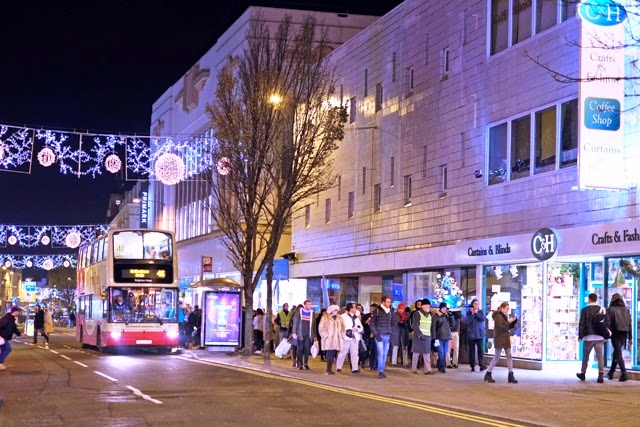
Stopping frequently to pray the Rosary, the procession made its way along the quiet and dark Upper North Street, then turned right and entered the brightly-lit Western Road, one of the main shopping streets. Bag-laden evening shoppers paused momentarily to gaze in puzzlement, faces peered down from passing busses, and one or two Starbucks’ customers looked up briefly before resuming their steamy coffees - this is Brighton, quirky, tolerant and ultra-liberal where the unusual is a momentary distraction.


The procession’s destination was the Clock Tower, a landmark structure in the centre of Brighton, built in 1888 to celebrate Queen Victoria’s Golden Jubilee. It is the primary crossroad of the city where roads from the railway station, the seafront, the Steine and the shopping areas converge. Usually busy, it was quite subdued this evening, the chill weather had sent people home early and the few remaining shoppers, tourists and early diners were rushing along with heads down and collars turned up.


The marchers gathered around the statue of Mary and for 15 minutes the centre of Brighton echoed with melodious praise to the Blessed Mother of God, the voices at times drowned by the roar of passing traffic. Then it was all over for another year and the procession broke into chattering groups and dispersed.

Did it make a difference? The witness, praise and prayer seemed almost overwhelmed by the indifference, single-minded consumerism and self-indulgence of onlookers on this chilly winter night. It may be a fancy but the bright full moon above Brighton this evening reminded me of ‘a woman clothed with the sun, and the moon was under her feet, and upon her head a crown of twelve stars.’ I imagine the procession made her very happy.

Wednesday, 26 November 2014

Sacred Heart Church's Winter Night Shelter Opens

The Sacred Heart Church's Winter Night Shelter opened last night and we had 14 guests, including one lady (we admitted female guests for the first time this year).

I was struck by the variety of nationalities involved this year. Talking with Fr Kevin afterwards, we reckoned that we spoke with people from 8-9 different countries; Eastern Europe was well represented as usual, with guests from Poland, Romania, Lithuania, Estonia and other countries – and our first Swiss guest!
Sadly, in many cases the guests are with us because of broken dreams. The dream of getting a job in the UK and being able to afford housing remains a dream. The reality is jobs that have fallen through, jobs that were advertised but never existed and jobs that were lost for unknown reasons. The reality is that savings are used up, housing is no longer affordable, and nights are spent outside trying to shelter from the wind, endless rain and bitter cold.

That’s where the shelter comes in. We provide warmth, safety, comfort, good food – Thai chicken curry from Maestro Georges last night – and companionship.
We also have fun doing it. As evidence, here is a photo of last night’s Evening Team - together with the famous beds and bags.