Sunday, 21 June 2015

London to Brighton Bike Ride 2015


Today, Brighton celebrated the arrival of the 40th annual London to Brighton Bike Run, organised by the British Heart Foundation charity. Twenty-two thousand riders poured into the city – among them Pippa Middleton, the Duchess of Cambridge’s sister, and the charity’s ambassador.

The 54-mile route, starting from London’s Clapham Common, moves south from the capitol’s crowded roads through narrow, quiet country lanes down to the sparkling blue Channel at Brighton. There are 15 rest stops on the route with toilets and refreshment stands.

It was a perfect day for cycling with temperatures in the mid-60s Farenheit (18 Celsius) and a strong, cooling westerly breeze. The stream of riders came pouring into town, along special lanes separated from the traffic by traffic cones, but stopping for red traffic lights, as commanded by marshals.
  
   
Then it was off again when the lights turned to green.


This rider was delighted to see the spires and domes of the 18th century Royal Pavilion, only a couple of minutes before the Finish line.


But first you have to continue down the Steine, past the end of the Palace Pier and then hang a left turn into Madeira Drive.


And, as he passes the Palace Pier, this Superman takes a selfie:


Passing the Brighton Wheel, its capsules rising to 50 metres above sea level.


Now, in front is the Finish Line and, behind it, the cranes mark the site of controversial new high-rise housing being built at Brighton Marina.


As the exhausted riders pass under the Finish Line, to hyper-excited commentary on the loudspeakers and the applause of the waiting crowds, they are welcomed with offers of cool water, first aid - and a medal!


I didn't have time to wander around and check out the riders but it's clear there are a variety of reasons for people to undertake this exhausting ride...including fun and celebration.


Before I left the seafront, I glanced out to sea and saw a ketch running parallel to the beach under furled job and mizzen - and if you look closely, just ahead of it to the port side is a jetski. It's funny, pictures of sea conditions rarely convey the apparent situation - it looked quite fresh out there with lots of white caps!  


And so, to home, the seafront still crowded...

Friday, 19 June 2015

Brighton’s Secret Catholic Archives

The purpose of the exhibition was to display photos and memorabilia from Brighton’s Catholic history. It was arranged by St John the Baptist Church, which is situated in Kemp Town, Brighton, and is doubly famous for being the oldest remaining Catholic Church in Brighton (founded 1835) and the only church to have as benefactress Maria Fitzherbert, a woman who had been married – but invalidly - to George, the Prince of Wales, also known as ‘Prinny’ (who would later become King George IV).


Maria Fitzherbert by Sir Joshua Reynolds, 1788
I thought this would be a normal exhibition – but I had reckoned without the genius of the organisers.

A normal exhibition would have been publicised widely, be opened by someone of stature (our new Bishop or the Mayor of Brighton & Hove or Canon Foley), be professionally displayed, well attended and hosted in a familiar venue.
...Not this exhibition.

It was due to open at 11am this morning and then run from 11am-6pm each day for a week until 25th June. The venue is the Fitzherbert Centre, an empty shell of a building owned by A&B Diocese. Once the Centre was a thriving primary school - it even served as a day resource for up to 40 homeless and isolated residents; however, a devastating arson attack in 2007 and what looks like a subsequent failure of imagination or funding left the building isolated and largely empty.
Peter and I arrived at just before 11am and managed a brief ‘hello’ to the departing Canon Foley. Was this an omen? There was a certain lack of spectators...well, there were none except possibly one lady who was wandering round, inspecting the exhibits very closely. The curator, Dr Sandy Kennedy, who was hurtling around at high speed arranging things, also disappeared on an errand.   

The Exhibition Room
We waited for the opening ceremony...and waited...and waited in vain. At ten past eleven we concluded that the exhibition had indeed opened but that we had missed the precise point at which this event happened. There were several display tables, a number of boards with photographs, and two or three areas with bunches of photographs waiting to be sorted and/or exhibited.

The central table contained a display of items owned by Maria Fitzherbert, companion to the future King George IV, patron of St John the Baptist Church and inspiration for the name of the building we were in.
Maria's Things
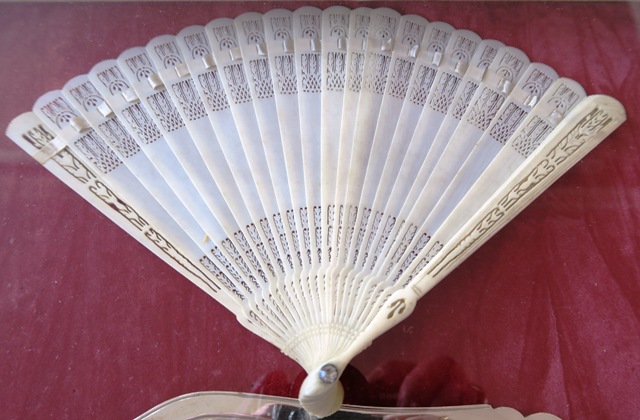
They were mainly secular and precious items; gold shoe buckles, gold bracelet, earrings, diamond hairpin, a gold watch, an ivory fan and so on.
I'm a Fan of Maria!
There was no display poster describing the importance of her faith to her, why her last marriage was invalid and the part that her Catholicism presumably played, a description of her philanthropy or even her character...a missed opportunity. (But, to be fair, there was a newspaper clipping from 1971 which credits her with accelerating the growth of Catholicism in the town through bringing her own priest to Brighton and offering local Catholics access to Mass at her private oratory).  
By all accounts, Maria was a strong and attractive character. Although her decadent, extravagant and serially-unfaithful ‘husband’ Prinny disowned her to marry Princess Caroline of Brunswick, he seems to have been besotted by Maria to the end of his life, keeping all her letters, even – allegedly – being buried with a picture of Maria’s eye (an eye-miniature). And Maria? Well, the story is that King William IV offered her a dukedom as compensation for her shoddy treatment by Prinny but she refused on the grounds that ‘she had borne through life the name of Mrs Fitzherbert; that she had never disgraced it, and did not wish to change it.’ Quite a lady!

The First Church!
There was a picture of the very first building in Brighton used for Catholic worship – something I had never seen before...rather unprepossessing - but its appearance is irrelevant.

St Thomas More - and visitor
There was a nice, workmanlike, but limited display from St Thomas More Church; a fine display from St John the Baptist; a large and varied display by the Poor Servants of the Mother of God; photos from St Joseph’s Convent;
 
some nostalgic photos of well-attended activities from St Mary’s; a rather puzzling display on the illness of the Vicar-General of Southwark in 1898; an extended history of relevant developments in the eighteenth and nineteenth centuries; some large bibles, colourful memorial displays and a variety of other items – including press cuttings on a claimed descendant of the presumed ‘love child’ of Prinny and Maria...from the sublime to the not-so-sublime.   
SVP Relief Books
As expected, the Saint Vincent de Paul (SVP) display was well set out and informative. I’m naturally biased, I contributed three Relief Books from Sacred Heart Church’s SVP group; these detail the weekly assistance given to needy people in the parish, the oldest book on display dates from 1916. The SVP Conference at Sacred Heart is the oldest in Brighton & Hove, being registered in 1907.

No, I don't know what it is!
Initially, I was puzzled at the lack of publicity, material, organisation and visitors to the display but it then struck me that this was a clever imitation of the Vatican’s famous Secret Archives - not publicised or easy to access, restricted to devout and dedicated enquirers, not all on display and parts open to interpretation.

I’m sure there is a great story waiting to be told about the history of Catholicism in Brighton & Hove but it will take time  - and funding – to conduct and assemble research, gather all the relevant artefacts, interpret them and document and display them in a way that does them justice.
And, perhaps by then the Fitzherbert Centre will be a Catholic Social Community Centre offering support to the elderly, isolated, homeless and the plain needy?             

Sunday, 7 June 2015

Wildlife Photographer of the Year


The sun was shining and a quartet was playing near the Royal Pavilion Cafe as I walked through the Pavilion Gardens on my way to Brighton Museum and Art Gallery.
It was almost exactly 200 years ago that the architect John Nash started transforming the old Pavilion building into the Indo-Islamic fantasy and royal residence that we know and love today. It will always be associated with George, Prince of Wales, who became Prince Regent in 1811 and loved to escape to the Brighton seaside where he could enjoy discreet liaisons with the twice-widowed Maria Fitzherbert. He even married her secretly in 1785 (secretly for several reasons, one of which was because she was a Roman Catholic) and, although the ‘affair’ had blown over by 1794, he never really got over her, keeping all her letters to him and even clasping a memento of her when he was on his deathbed in 1830. Maria died a few years later and was buried in the first Catholic church in Brighton, St John the Baptist, which she funded.


Today, crowds were sprawled on the lawns enjoying the sun, children were playing, two guys with afros and rasta beanies were busking, lost in their own rhythm.


Brighton Museum and Art Gallery is hosting the 2014 Wildlife Photographer of the Year touring exhibition with 100 of the best photographs on display. The 2014 competition was the 50th annual event, which is run each year by the BBC and the Natural History Museum.


The photographs were displayed on panels in darkened rooms – that also held stuffed birds from the local Booth Museum and other displays to supplement the exhibition. Each item had an accompanying description that included the relevant photo-taking details (camera make and model; lens; aperture; shutter; ISO; flash used etc).

(I’m a bit of a camera anorak so I made a tally of the winning camera manufacturers. As expected, the big two manufacturers, Nikon and Canon, accounted for 97% of the photos exhibited, and each provided roughly half of the entries with the Canon 5D3 and the Nikon D800 well represented).


Here are some of the photos that I found particularly memorable:
THE LAST GREAT PICTURE – the overall winner - the sun’s setting rays warmed Tanzania’s Serengeti National Park and the rock outcrop on which a pride of 14 lions lounged, most asleep, some watchful. The photographer, Michael Nichols, tracked the lions for six months before managing to take this stunning photo – in black and white.

THE MOUSE, THE MOON AND THE MOSQUITO – this is the first photo that you see as you enter the gallery. It was taken at night, with flash, as a deer mouse, whiskers aquiver, perched on a giant puffball mushroom, looks at a hovering mosquito caught in the light of the full moon, which is rising in the background.
TOUCHÉ – a sword-billed hummingbird uses its giant beak to ‘see off’ an attacking collared inca bird. The hummingbird uses its long bill to suck nectar from deep flowers – it is the only bird with a bill longer than its body length (excluding the tail). The photo captures the split-second drama of the battle and was taken with a flash lasting one ten-thousandth of a second!  

HOLLYWOOD COUGAR – the photographer Steve Winter had the idea of photographing a wild cougar in front of the ‘Hollywood’ sign outside Los Angeles so he set up a camera with a tripwire – and waited 14 months until one night a cougar set it off and photographed itself against the famous illuminated sign. Cougars (also called mountain lions or pumas) are seven to eight feet long, weigh 100-150 pounds and are domestic to the Americas, ranging from Canada to Chile. Big pussies!
CARDINAL SPARKS – this photo was taken underwater and is an explosion of colour involving intricate twisting sinuous tentacles of anemones and flitting cardinalfish; a natural and colourful underwater ‘spaghetti junction’.  

The exhibition is on until 6th September 2015 (non residents beware: the Museum & Art Gallery, which formerly had free entry, introduced an entry charge - £5 for adults – from three weeks ago).

Friday, 29 May 2015

Installation of Bishop Richard Moth

(for photos of the Installation Ceremony, please refer to Mazur Installation  )

Yesterday Richard Moth was installed as the fifth Bishop of Arundel & Brighton Diocese on the same date as the diocese itself was established, fifty years ago.
The cathedral of Our Lady & St Philip Howard at Arundel was the scene of a spectacular ceremony, with all the pomp, stirring music and solemnity that the occasion merited. There were two Cardinals, two Archbishops, more than 20 Bishops, around 200 priests and deacons, representatives of Pope Francis, the Queen and civic dignitaries, a mace bearer, clergy of other faiths and several hundred guests.

There were also Knights and Dames of several Orders – and two particularly caught my eye; the Knights of the Equestrian Order of the Holy Sepulchre of Jerusalem were dressed in long white wool capes reaching almost to their ankles, embroidered on the shoulder with the red cross of the order, and wearing large, floppy black berets, while their wives, the Dames, were equally majestic in ankle-length black velvet capes and black mantilla lace veils; the Knights of Saint Gregory the Great were dressed in natty green uniforms, beribboned black beaver-felt hats with ostrich feathers, pearl-handled short swords at their sides. (If you’re wondering, I wore a blue hound’s tooth jacket crafted some 20 years ago by Gilberto’s of New York and a silver diamond-patterned tie, St Michael’s brand...no hat.)
The ceremony began just before 3pm with soaring organ music, pieces by Bach, Vaughan Williams and Foster, while the dignitaries processed down the aisle to their seats, followed by a seemingly never-ending procession of clergy; tall and small, skinny and tubby, sprightly and arthritic, hirsute and bald, rigidly focused and gazing around, solemn and jovial.

As they entered we sang a litany of praise to the saints – 124 names in all, read in batches of between five and 13 at a time, interspersed by the sung appeal ‘Saints of God, come to our aid!...’ It seemed interminable and I suspect we were all relived when we could resume our seats.
My seat was on the right side of the nave, facing the altar, which was about fifty feet away, partly obscured by two large pillars. On the wall just above me was a consecration cross, marking the point where the Bishop had anointed the wall with chrism or holy water on its consecration. As is common, there was a candle-holder fixed to the wall in front of the cross. It held a small burning candle and I watched in fascination as the candle burned down completely during the ceremony, hot wax spilling over the edge and narrowly missing the lady in front of me.

Please turn to face the west door.’ The command was given and we all stood and faced the main entrance door. The Provost and Chapter of Cannons formally welcomed Bishop Richard Moth, and then the cathedral clergy, led by the Dean Tim Madeley, entered the cathedral and processed the Bishop to the sacristy where he vested for Mass. At this point the organ and massed choir gave tremendous voice to Newman’s popular hymn that begins ‘Praise to the Holiest in the height, and in the depth be praise’.
The Holy Mass then began, presided over initially by Archbishop Peter Smith, Metropolitan of Southwark Diocese, who acted as Apostolic Administrator of the Arundel & Brighton Diocese following the resignation of the previous bishop, Kieran Conry.

Have we a mandate from the Holy See?’ queried the Archbishop in a loud stage voice. Well, of course we do, and the Chancellor of the Diocese then read Pope Francis’ mandate – officially called the Bull of Appointment – in the original Latin followed by a translation. The Pope’s Bull officially appoints Bishop Richard to the Diocese and offers warm good wishes and prayers for his success. The document was then displayed to the College of Consultors and to the assembly before it was returned to the Apostolic Nuncio, Archbishop Mennini, who presented it to Bishop Richard who then formally accepted responsibility for Arundel & Brighton Diocese.
At this point, Archbishop Smith led Bishop Richard to the ‘Cathedra,’ the Bishop’s throne chair, pronounced the formal words of installation over him, and presented him with the Crozier, the shepherd’s crook symbolic of his role as shepherd of the faithful in the Diocese.  

Now, fully Bishop of Arundel & Brighton, Bishop Richard Moth stepped down from the altar to greet some of the clergy, representatives of Her Majesty the Queen and civic and religious leaders.
From this point onwards Bishop Richard was the chief Celebrant of the Eucharist, which unfolded in time-hallowed tradition with the Gloria, Collect and Liturgy of the Word, including the homily.

In his homily Bishop Richard paid warm tribute to his predecessors in the chair, and reminded us that there is only one subject of the Church’s focus, the person of Jesus Christ. Calling for a renewal of the Church’s mission so that all may ‘Taste and see that the Lord is good’ Bishop Richard asked for a commitment to ever-deeper prayer and the growth of our understanding of the gift of faith. Like Jeremiah, we may not feel up to the task but our role is to leave the sheepfold to share our joy with others so that they also may see that the Lord is good.
Bishop Richard then presided over the Liturgy of the Eucharist, surrounded by 200 priests and deacons of the Diocese, with assorted bishops, archbishops and cardinals.

It is appropriate to give special mention to the MC and cantor, Catherine Christmas, the Diocese’s Specialist Adviser on Liturgy and Music, who was outstanding in her role of providing announcements to facilitate the proceedings in a seamless way while demonstrating to the assembly how to sing the music.
At the conclusion of the Mass, Archbishop Mennini, the Apostolic Nuncio, rose to convey to  Bishop Richard the thanks and prayers of the Holy Father. The Archbishop was born in Rome and has a pronounced accent that, in conjunction with a temperamental sound system, made parts of his speech inaudible from where I was sitting. At one stage I guessed (and hope) that he made a joke as the first few rows of people burst into laughter.

Cardinal Cormac Murphy-O’Connor, 82 years old, a large avuncular man, himself a former Bishop of the Diocese and much-loved locally, rose to add his congratulations. Again, I could hardly hear his words but at one point he referred to a memorable cricket match between the Bishop’s Eleven and the Duke of Norfolk’s Eleven, which the clergy won. He ended by assuring us that the Diocese was ‘in good hands.’  
Then, two hours after we first entered the cathedral, we poured out into the late afternoon sunshine, discussing the experience. General agreement was that it was a spectacular event, uplifting, richly spiritual and hugely impressive. There was general agreement that the new bishop had presided with an appropriate authority, dignity and warmth that bode well for the diocese and we concluded that we were indeed ‘in good hands.’

By kind invitation of the Duke of Norfolk, the assembly then made its way to Arundel Castle, just a few hundred yards from the Cathedral, for a reception.

The earliest parts of the castle date from 1067 but the reception was held in the magnificent Baron’s Hall, a late Victorian replacement on the site of the original medieval hall. With its high ceilings, minstrels’ galleries at each end, paintings and ornate fireplaces, the hall is a very suitable location to retain the magnificence of the recently concluded ceremony of Installation. Now, it was filled with several hundred guests, black-suited clerics mingling with religious, uniformed and be-medalled armed forces chaplains holding forth to each other, nuns picking at the platters of nibbles, waiters circulating with trays of drinks around the occasional bobbing biretta, black or reddish-rose.


Glass in hand, I was circulating when my eye was caught by a glass display case against one wall. Among the various items was a 19th century gilt French reliquary - containing a relic of Saint Vincent de Paul...


as a member of the SVP, this was a perfect end to the day so I made my way out, under the portcullis and to where my car was parked.


........................................................................................................................................
Already, inevitably, the analysis of the Installation has begun. What signs and portents are there of this new bishop, particularly, is he a liberal or a conservative? Priest-blogger Fr Ray Blake (  http://marymagdalen.blogspot.co.uk/ ), under the heading ‘Impressive’ has listed some of the signs he considers favourable; the Propers sung in Latin, use of a dalmatic vestment, wearing a choir cassock for the Mass and habito piano (whatever that is!) for the Reception, singing most of his parts for the Mass...

Regardless of the new bishop’s motivation and preferences, I suspect the overwhelming priority and concern for the next few years will be the very practical one of replacing ageing clergy and religious, consolidating parishes and co-opting lay support. The good news is that average Mass attendance in A&B Diocese has remained just over 40,000 for the last ten years and the number of permanent deacons has more than doubled to 40. I am certain that Bishop Richard will bring strong leadership and focus to these issues, uniting the Diocese in faith and mission on 5th July at the Amex Stadium – while also giving us notice to leave the sheepfold!             

Friday, 22 May 2015

Salt and Silver

At the beginning of the year I hugely enjoyed the 'Drawn by Light' exhibition at the Science Museum, a display of 200 of the earliest photographs (drawn-by-light).


Yesterday, in a bit of a re-play, I went along to the Tate Britain art gallery on London's Millbank, on the side of the Thames, which has an exhibition - Salt and Silver - of early salt prints that continues until 7th June.


Salt prints are the first photographs on paper that still exist today. The process was discovered about 12 years after the very first photographic image was created. It was the scientist William Henry Fox Talbot in the late 1830s who experimented with exposing paper coated with silver salts to light through a lens. He found that the chemicals turned black in the light areas and stayed light in the shadows, creating what we now call a 'negative'. (It's the same process that causes silver cutlery to tarnish and turn black; the salt stops the process, enabling a moment in time to be frozen). By shining sunlight through this negative onto another paper, also coated with silver salts, he created the first paper-based black and white 'positive' photographs.

Interestingly, at the very same time he announced this discovery - 1839 - a Frenchman Louis Daguerre was busy inventing the 'daguerreotype' a similar image recording system using a highly polished silver-plated copper sheet. Initially popular, both salt prints and the daguerreotype had largely died out by the mid-1860s. Daguerreotypes were technically superior, being sharper and more detailed, but, using silver-coated copper as the base, they were also more expensive. Both processes would be superseded by the albumen method of making prints.

There are 90 rare salt prints on display at the Tate. They are rare because they are fragile, few have survived and those that have need to be curated carefully to ensure preservation; the display at the Tate is the first ever devoted to salt prints in Britain. It is carefully lit, simply displayed and the accompanying textual description is kept to a minimum to avoid distracting from the photos.

All the usual suspects are on display including Fox Talbot, David Octavius Hill, Robert Adamson, Roger Fenton, Matthew Brady, J-B Frenet etc., but also quite a few less well-known photographers. As in early Victorian times, professional photographers are few, these are mostly gentlemen-amateurs, scientists, painters, lawyers politicians and so on. The subjects are equally varied; nature, landscapes, architecture, ruins, portraits, war reportage, technological progress, natural disasters and so on. 

I'd love to discuss individual exhibits in some detail but - in an unaccustomed display of frugality - I refused to pay £35 for the catalogue with its bare-bones display of prints and its inclusion of some learned experts' roundtable padding. I see that new and used copies are still priced at £35 upwards on Amazon...sigh.

Some striking examples that I recall are:

Roger Fenton's portraits of the Crimean War, especially Captain Lord Balgonie, Grenadier Guards, 1855, taken in civilian dress, once a hero, now his face haggard and haunted by the fearful misery of war...the same thousand-yard stare seen in Don McCullin's photos of soldiers in the Vietnam War, 113 years later.

Compare that photograph to one he took of a French cantiniere (mess servant) from the same war, her uniform pristine and shiny, looking for all the world like she has been plucked from a dinner party and dropped into the carnage.

Then there are all the early pictures of ancient ruins, like Eugene Piot's photo of the Parthenon from the Acropolis or Linnaeus Tripe's views of Sri Meenakshi Temple in India, or numerous studies of Egyptian relics; bereft of tourists, half buried in sand or incompletely excavated, they look like they have just been discovered - and can be as easily forgotten.

Initially, Paul Mares' Ox Cart, Brittany seems a scene of rural charm, an ancient wooden cart parked outside an equally ancient cottage - but then the eye is drawn to two roughly painted white crosses on the wall - a sign common since medieval times that is used to warn of the presence of a deadly disease inside, perhaps plague.

The portraits are a study in themselves. In early Victorian times, portraits of eminent men were carefully posed to convey a weighty, solemn impression of worthiness and probity. Happily, some of the photos in this exhibition also capture a more natural joie de vivre, especially of families and children - not forgetting David Hill and Robert Adamson's wonderful naturalistic studies of Newhaven Fishermen.

...the exhibition closes on  7th June - hurry along!

Wednesday, 20 May 2015

Coin Collecting

One of the great qualities of Sacred Heart Church is the variety of folk who worship there, about 600 to 700 souls from over 40 different countries.


I was reminded of that yesterday when I received the results of a charity collection that we held in the church recently. We had asked for 'unwanted old and foreign' coins and notes for the Saint Vincent de Paul (SVP) charity to be used in its charitable work on supporting the poor and needy, here and overseas. The idea was that the contribution would be channelled via a commercial bureau de change who would convert the funds into Pounds Sterling and then pay the converted funds over to the SVP.

We collected the excellent total of about 5Kg weight of coins and notes - the great majority of it being foreign coins that had found their way into the collection plates and candle boxes of the church over the last few years.

All the Euro coins could be readily converted into Pounds, as could the coins and notes of quite a few other countries, however, there were coins weighing about 2Kg that could not be converted and had to be sold as bullion for recycling.

That was because the coins in question were of too low value to make economic conversion or because they were very old and no longer in circulation (and not sufficiently desirable to collectors). The countries that these coins came from were Argentina, Bahrain, Barbados, Botswana, Columbia, Croatia, Cyprus, Czech, Danish, Egypt, Estonia, France, Ghana, Greece, Hungary, Iceland, India, Israel, Italy, Kenya, Korea, Latvia, Lithuania, Malaya, Malta, Netherlands, New Zealand, Oman, Philippines, Polish, Portugal, Russia, Seychelles, Slovakia, South Africa, Spain, Sri Lanka, Sudan, Sweden, Trinidad & Tobago, Tunisia, Turkey, Uganda, Uruguay, Venezuela and Zimbabwe.

Reading the list, I was again reminded of what a marvellously diverse - 'catholic' with a small c - church we are...or maybe our members are just well-travelled!   

Sunday, 17 May 2015

Phoney Summer in Brighton

You could be forgiven for thinking that summer had arrived. It was 35 degrees in my conservatory today (that's 86 Farenheit) and it seemed as hot in the car, driving into Brighton. However, once out of the car, the strong chilly wind blowing off the English Channel reduced the temperatures to a much more modest 15 (59) and it felt even cooler than that.

Brighton Festival is in full swing and I passed what is grandly called 'Fringe City' on the way to the beach.


There were the usual buskers and entertainers but the one that caught my eye was the balloon blower who, with a couple of ropes and a perfectly-timed swing, was creating huge multicoloured bubbles from a bucket of suds.


 The kids were delighted, chasing the bubbles and trying to burst them. A simple idea - but so much fun!


A few streets away is an interesting sight - almost 200 old sewing machines in the window displays of this clothing shop - wow!


Closer to the beach the restaurants were doing good business, lots of tables and chairs on the pavements.


This particular spot is popular with hawkers and entrepreneurs of various kinds; jewellery and necklace sellers, bag vendors, masseurs, eyebrow pluckers and tarot readers like the lady below.


Just off the beach, at Madeira Drive, is the object of my curiosity, the mini cars that have arrived from London following the 30th annual London to Brighton Mini Run. The event attracts owners from all over the world and about 2,500 minis make the 55-mile run from Crystal Palace Park in London to Brighton's Madeira Drive. When I arrived there were still several dozen cars parked there.


I'd quite forgotten how small the original minis designed by Alec Issnigonis and produced between the years 1959 and 2000 were. Look at the contrast between this spectator and the almost-toy car he is viewing - I don't think he would have been very comfortable in it!

 
For grease-monkeys there were plenty of engines to inspect...


...and spares to buy.


I followed the sound of drumming to the promenade and found an energetic group of dancers performing to the percussive pounding of an African drum. Their energy, acrobatics and good humour was well rewarded in donations. And it was a great way of keeping warm!


The fish 'n' chip and ice cream sellers were busy and further along the promenade more sedate games of crazy golf were underway in that most traditional of seaside pastimes...

 
In fact, probably the only more traditional pastime than eating is fish 'n' chips at the seaside during the Phoney Summer season is lying, fully clothed, on the uncomfortable pebbly beach, shivering slightly and wondering whether the exposed parts will get a tan or chilblains...


Hurry up Real Summer!